letter boxed answers
Introduction to Letter Boxed Answers
Letter boxed answers have quietly become one of the most engaging and intellectually satisfying puzzle formats in recent years. If you’ve ever found yourself staring at a square filled with letters arranged around its edges, trying to form words that follow specific rules, then you already know how addictive this puzzle can be. At first glance, it looks simple—just connect letters to form words—but once you dive in, it becomes a true test of vocabulary, logic, and strategy.
What makes letter boxed answers so fascinating is the balance between creativity and constraint. You’re not just forming random words; you’re working within a structure where each move matters. The letters are placed on different sides of a box, and the challenge lies in forming words without using consecutive letters from the same side. This small rule changes everything. It forces you to think differently, to explore words you might not normally use, and to stretch your mental flexibility.
In this guide, we’ll go far beyond the basics. You’ll learn how letter boxed answers work, why they’re so popular, and how to consistently solve them like a pro. Whether you’re a beginner or someone who already dabbles in daily puzzles, this article will give you the tools and mindset needed to improve dramatically.
What Are Letter Boxed Answers?
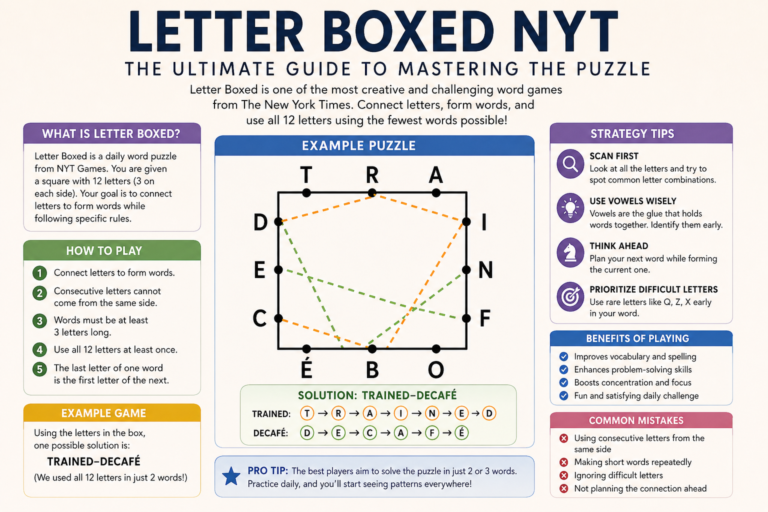
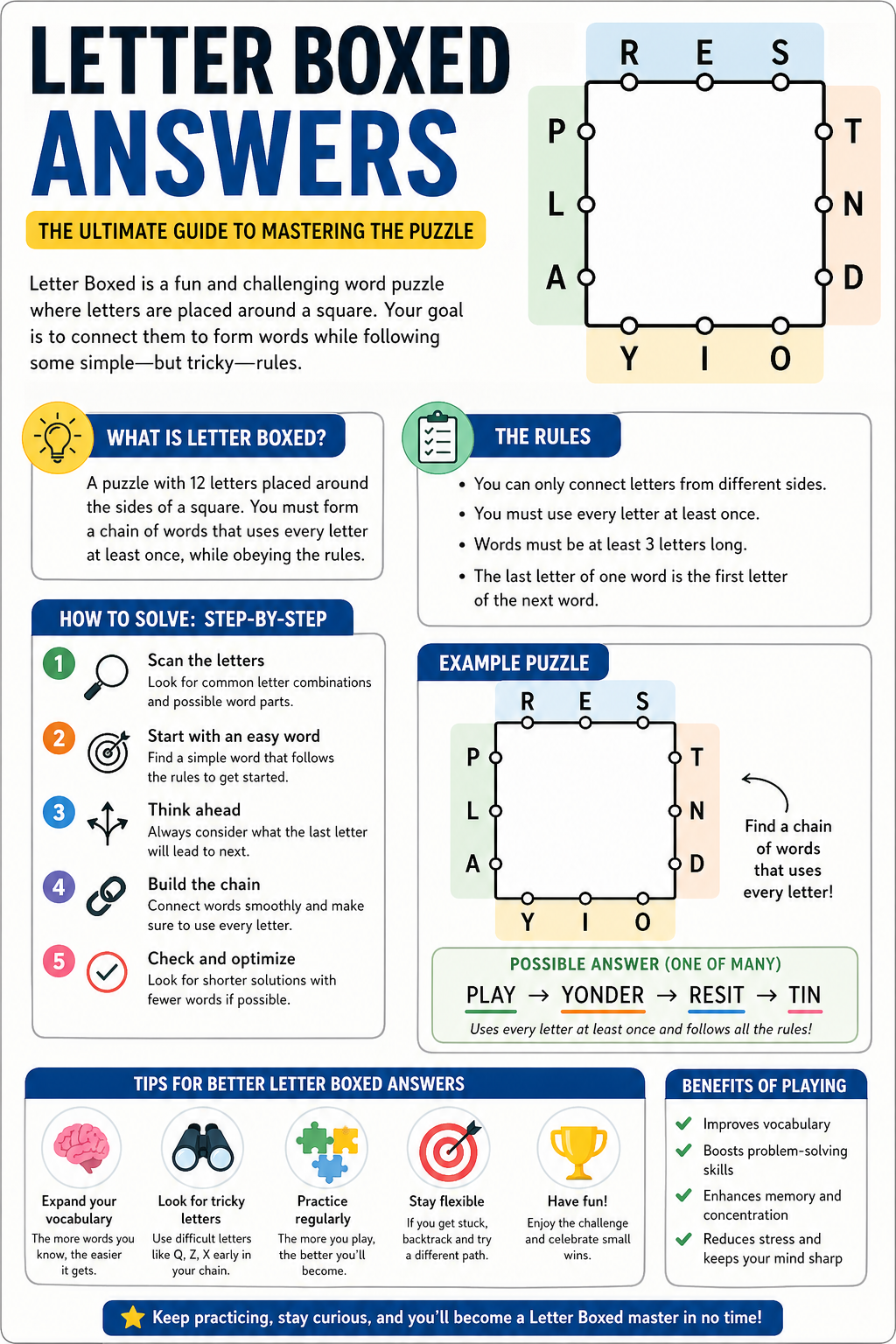
Letter boxed answers refer to the solutions created in a puzzle where letters are arranged on the four sides of a square. The goal is to connect these letters into words while following a specific rule: you cannot use two consecutive letters from the same side of the box. Sounds easy? Not quite.
Each puzzle typically contains 12 letters, with three letters on each side of the square. The solver must form words that collectively use all the letters at least once. The final solution is often a chain of words where the last letter of one word becomes the first letter of the next. This chaining effect adds another layer of complexity and elegance to the puzzle.
Another interesting aspect is that there’s rarely just one correct solution. There can be multiple valid letter boxed answers, but the challenge often lies in finding the most efficient solution—usually the one with the fewest words. This encourages optimization and strategic thinking rather than just brute-force guessing.
Because of these characteristics, letter boxed answers sit at the intersection of vocabulary building, pattern recognition, and problem-solving. They’re not just games; they’re mental workouts that sharpen your brain over time.
The History and Popularity of Letter Boxed Puzzles
Letter boxed puzzles gained mainstream attention through digital platforms, especially as part of daily puzzle collections offered by major publications. Their rise in popularity can be attributed to the growing demand for short, engaging, and mentally stimulating activities that people can enjoy daily.
Unlike traditional crosswords, which can sometimes feel overwhelming, letter boxed puzzles are compact and approachable. You don’t need to fill an entire grid or rely heavily on obscure trivia. Instead, you focus on word construction and logical connections, which makes the experience more intuitive and rewarding.
Another reason for their popularity is the sense of achievement they provide. Solving a letter boxed puzzle, especially in just two or three words, feels like cracking a code. It gives a quick dopamine boost without requiring hours of effort. This makes it perfect for busy individuals who want a mental challenge without a huge time commitment.
Over time, communities have formed around these puzzles, with enthusiasts sharing their letter boxed answers, discussing strategies, and even competing to find the most efficient solutions. This social aspect has further fueled their growth and appeal.
Understanding the Rules of Letter Boxed Answers
To master letter boxed answers, you must first fully understand the rules. While they may seem straightforward, each rule plays a crucial role in shaping the puzzle’s difficulty.
First, you can only connect letters from different sides of the box. This means if your last letter came from the top side, your next letter must come from either the left, right, or bottom side. This rule forces you to think spatially, not just linguistically.
Second, every letter in the box must be used at least once across your final solution. This ensures that you don’t ignore difficult letters and encourages you to find creative ways to incorporate them.
Third, words must be valid dictionary words. No abbreviations, proper nouns, or made-up terms are allowed. This rule keeps the puzzle grounded in real language and tests your vocabulary depth.
Finally, the words must connect. The last letter of one word becomes the first letter of the next. This chaining requirement adds a layer of continuity and forces you to plan ahead rather than thinking in isolated chunks.
Understanding these rules is the foundation. Once you internalize them, you can start focusing on strategy and efficiency.
Why Letter Boxed Answers Are So Addictive
There’s something uniquely satisfying about solving letter boxed answers. It’s not just about finding words—it’s about discovering connections and patterns that weren’t obvious at first.
One reason for their addictiveness is the immediate feedback loop. You either find a valid word or you don’t. This quick validation keeps you engaged and encourages experimentation. You can try different combinations rapidly, learning from each attempt.
Another factor is the sense of progression. At first, you might struggle to find even one valid word. But as you practice, you start seeing patterns more quickly. You recognize common letter pairings, identify useful prefixes and suffixes, and develop an intuition for what might work.
The puzzle also taps into our natural love for language. Words are familiar, yet when placed in this structured format, they become something new and challenging. It’s like rediscovering language from a different perspective.
Finally, the challenge of optimization—finding the shortest possible solution—keeps even experienced players coming back. There’s always room for improvement, and that’s what makes it endlessly engaging.
Step-by-Step Approach to Solving Letter Boxed Answers
If you want to consistently solve letter boxed puzzles, you need a systematic approach. Random guessing might work occasionally, but a structured method will yield better results over time.
Start by scanning the letters and identifying any obvious word fragments. Look for common prefixes like “pre,” “un,” or “re,” and suffixes like “ing,” “ed,” or “tion.” These building blocks can help you form your first word.
Next, focus on the more difficult letters. Some letters, like Q, Z, or X, can be tricky to incorporate. Try to use them early so you don’t get stuck later. It’s often easier to build around these letters than to force them in at the end.
Once you’ve formed your first word, think ahead. The last letter of your current word will determine the starting point of your next word. Choose words that end with versatile letters, giving you more options for continuation.
Finally, aim for efficiency. Instead of creating many short words, try to form longer words that cover more letters. This will reduce the total number of words needed and improve your overall solution.
Common Mistakes to Avoid
Even experienced players can fall into certain traps when working on letter boxed answers. Recognizing these mistakes can save you time and frustration.
One common mistake is focusing too much on one area of the box. Because of the side restriction rule, you need to constantly shift between sides. If you get stuck on one side, you’ll limit your options.
Another mistake is ignoring difficult letters until the end. This often leads to dead ends where you can’t form a valid word that includes those letters. Always try to incorporate challenging letters early in the process.
Overcomplicating is another issue. Sometimes the simplest solution is the best one. Don’t overlook common words just because you’re searching for something more complex.
Lastly, failing to plan ahead can derail your progress. Always consider how your current word will connect to the next. A great word that leads to a dead end isn’t helpful in the long run.
Advanced Strategies for Better Letter Boxed Answers
Once you’re comfortable with the basics, you can start applying advanced strategies to improve your performance.
One powerful technique is backward thinking. Instead of starting with the first word, think about how you might end the puzzle. This can help you identify words that neatly tie everything together.
Another strategy is grouping letters. Look at the box and mentally group letters that commonly appear together. This can help you spot potential words more quickly.
You can also practice pattern recognition. Over time, you’ll start noticing recurring combinations and structures. This experience will allow you to solve puzzles faster and more efficiently.
Finally, don’t be afraid to experiment. Try different approaches, even if they seem unconventional. Sometimes the best solutions come from thinking outside the box—literally.
Tools and Resources to Improve Your Skills
While letter boxed puzzles are meant to challenge your brain, there’s no harm in using tools to enhance your learning.
Word lists and dictionaries can be incredibly helpful. They expand your vocabulary and expose you to new word structures. The more words you know, the easier it becomes to form valid combinations.
Online communities are another great resource. Engaging with other puzzle enthusiasts allows you to learn new strategies and see different approaches to the same puzzle.
Practice is, of course, the most important tool. The more puzzles you solve, the better you’ll become. Consistency is key, so try to make it a daily habit.
You can also keep a personal journal of your solutions. Reviewing past puzzles can help you identify patterns in your thinking and areas for improvement.
The Cognitive Benefits of Solving Letter Boxed Answers
Beyond entertainment, letter boxed answers offer significant cognitive benefits. They engage multiple areas of the brain, making them an excellent mental exercise.
First, they improve vocabulary. By constantly searching for new words, you naturally expand your linguistic knowledge. This can have a positive impact on communication skills.
Second, they enhance problem-solving abilities. The need to follow specific rules while achieving a goal mirrors real-life challenges, helping you develop critical thinking skills.
Third, they boost memory and concentration. Keeping track of used letters and planning future moves requires focus and mental agility.
Finally, they provide stress relief. Engaging in a challenging yet enjoyable activity can help you relax and take your mind off daily pressures.
Tips for Beginners Starting with Letter Boxed Answers
If you’re new to letter boxed answers, don’t worry—it’s normal to feel overwhelmed at first. With a few simple tips, you can get started on the right foot.
Begin with patience. It might take time to find your first word, but that’s part of the learning process. Don’t rush or get discouraged.
Focus on small wins. Even forming one valid word is progress. Celebrate these moments and build on them.
Use trial and error. Experiment with different combinations and learn from your mistakes. Each attempt brings you closer to the solution.
Lastly, enjoy the process. Letter boxed puzzles are meant to be fun. Treat them as a game rather than a test, and you’ll find yourself improving naturally.
Conclusion:
Letter boxed answers are more than just a puzzle—they’re a journey into the depths of language and logic. They challenge you to think creatively, plan strategically, and push the boundaries of your vocabulary.
By understanding the rules, avoiding common mistakes, and applying advanced strategies, you can transform from a beginner into a skilled solver. The key is consistency and curiosity. Keep exploring, keep experimenting, and most importantly, keep enjoying the process.
With time and practice, you’ll find that what once seemed difficult becomes second nature. And when you finally crack a puzzle in just two perfectly connected words, you’ll know that all your effort has paid off.
So go ahead—dive into the world of letter boxed answers and discover just how rewarding this unique puzzle can be.
you may have missed
letter boxed answers
About the Author