letter boxed nyt
Introduction to Letter Boxed NYT
If you’ve ever opened the puzzle section of The New York Times, chances are you’ve come across the cleverly addictive game known as Letter Boxed NYT. At first glance, it looks simple—just a square with letters on each side—but don’t be fooled. This puzzle has a sneaky way of pulling you in and keeping you hooked for hours.
Letter Boxed NYT is part of the growing collection of word games offered by New York Times Games, alongside popular titles like Wordle and Spelling Bee. Unlike those, though, Letter Boxed stands out because it challenges not just your vocabulary, but also your strategy and pattern recognition skills.
In this guide, we’ll break down everything you need to know—from how the puzzle works to advanced strategies that can help you consistently solve it in fewer words. Whether you’re a beginner or someone trying to sharpen your skills, this article will give you a solid edge.
What is Letter Boxed NYT?
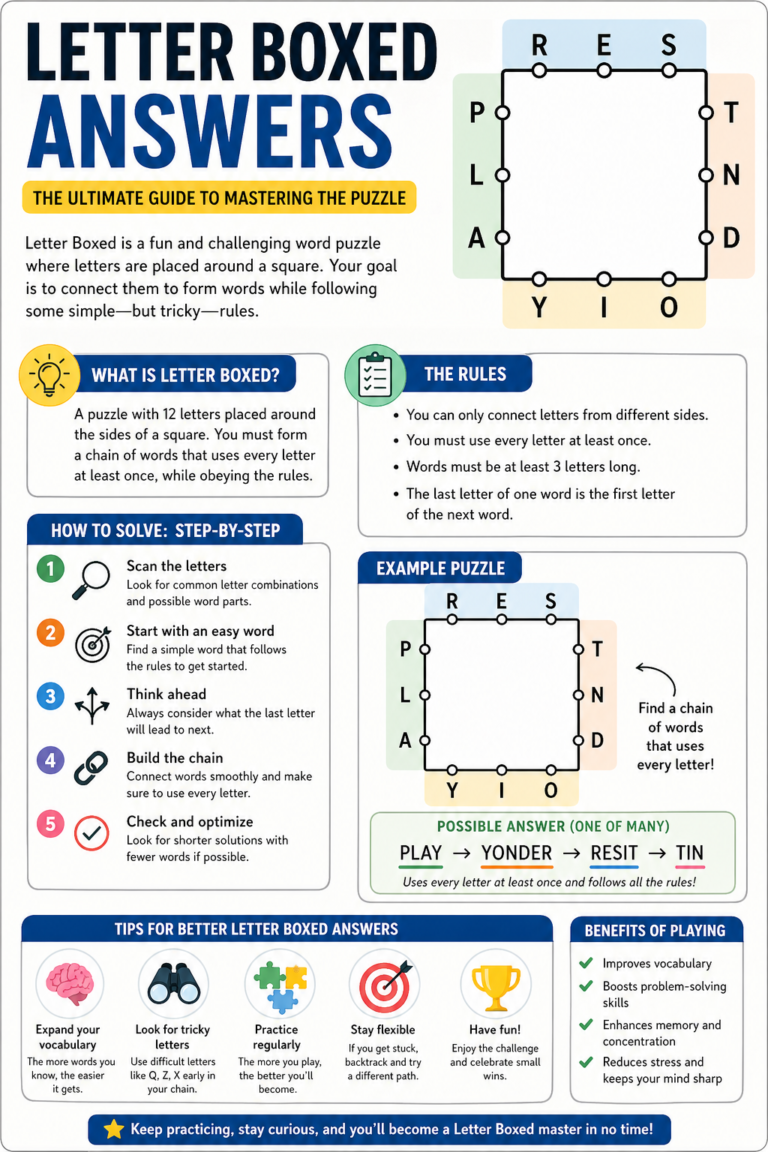
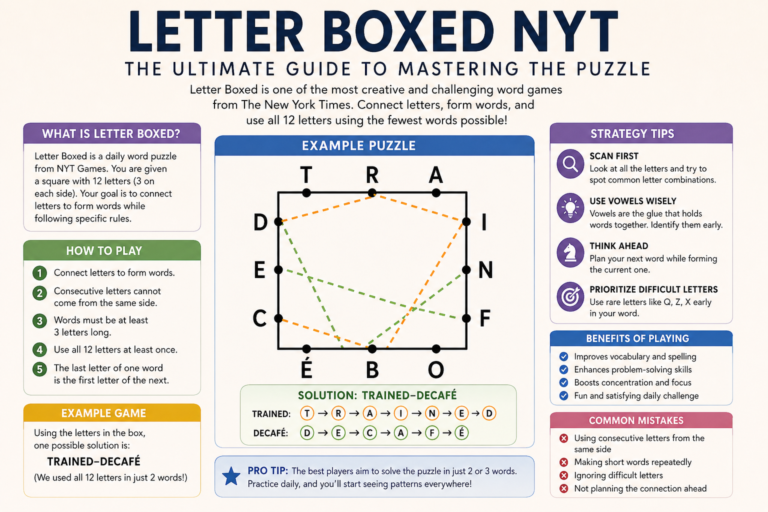
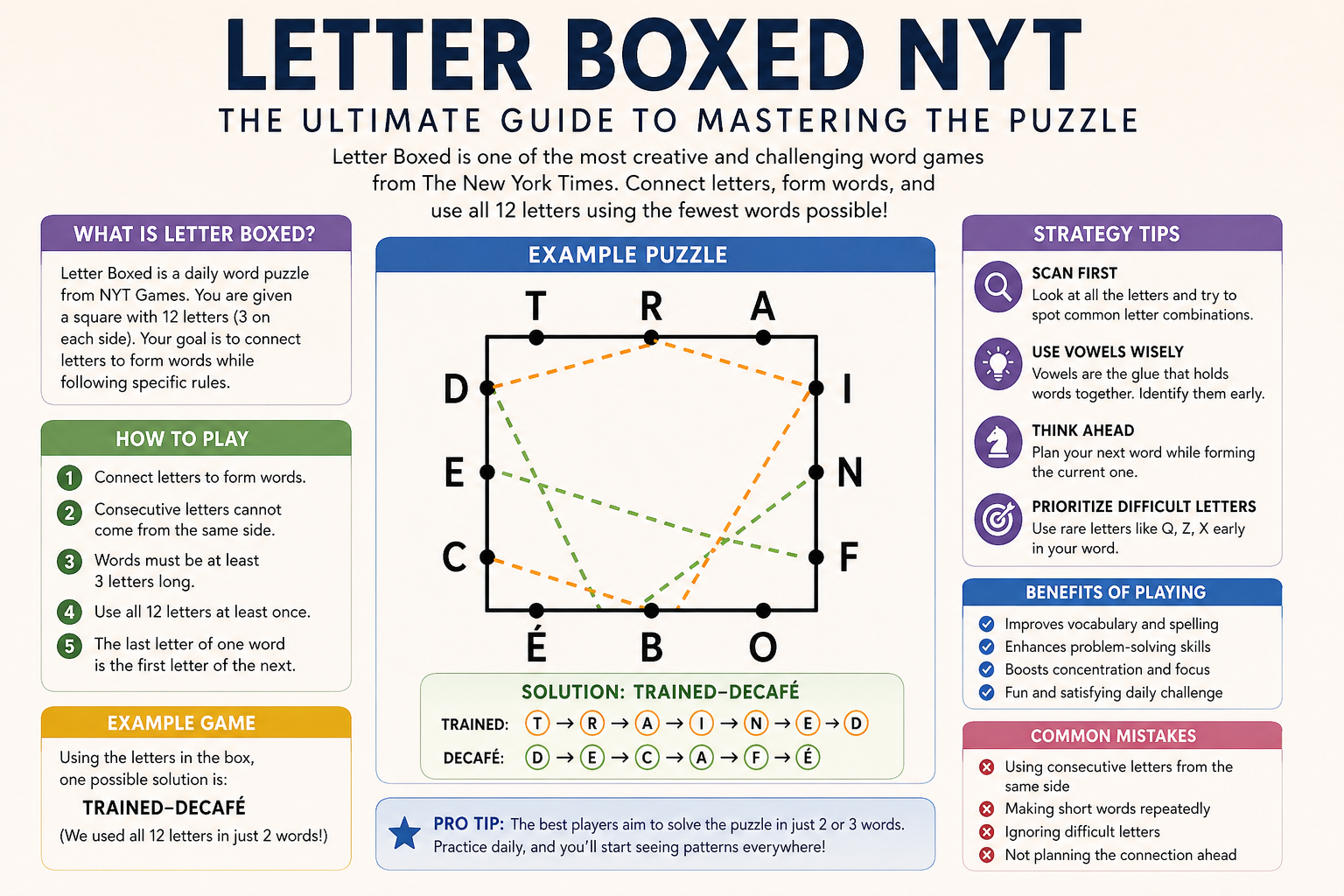
Letter Boxed NYT is a daily word puzzle where players are presented with a square box containing 12 letters—three on each side. The goal is simple in theory: connect letters to form words while following a few strict rules.
The twist is that you cannot use consecutive letters from the same side of the box. This restriction forces you to think creatively and prevents easy word formation. Each word you create must also connect to the next word, meaning the last letter of one word becomes the first letter of the next.
What makes Letter Boxed NYT so compelling is that there’s no single “correct” answer. Instead, the challenge lies in solving the puzzle using as few words as possible—ideally two or three. That’s where the real skill comes into play.
How Letter Boxed NYT Works
Understanding the mechanics of Letter Boxed NYT is crucial if you want to improve. The game gives you a square with letters arranged on four sides, and your job is to use all 12 letters at least once.
The rules are straightforward:
- You can connect letters to form words
- Consecutive letters cannot come from the same side
- Words must be at least three letters long
- Proper nouns and abbreviations are not allowed
Once you form a word, the last letter becomes the starting point for your next word. This chaining mechanic is what makes the game both challenging and satisfying.
At first, you might find yourself using four or five words to complete a puzzle. But with practice, you’ll start spotting patterns and reducing your solutions to just two or three words—something experienced players strive for.
Why Letter Boxed NYT is So Popular
There’s a reason why Letter Boxed NYT has become a favorite among puzzle enthusiasts. It strikes the perfect balance between simplicity and challenge.
First, it’s incredibly accessible. You don’t need advanced knowledge or special skills to start playing. If you know basic English vocabulary, you’re good to go.
Second, it offers a daily challenge. Just like Wordle, the once-a-day format creates anticipation. Players return daily to test themselves and improve.
Finally, there’s the satisfaction factor. Solving a puzzle in just two words feels like a major achievement. It’s that “aha” moment that keeps players coming back.
Basic Strategies for Beginners
If you’re new to Letter Boxed NYT, it’s easy to feel overwhelmed. But don’t worry—everyone starts somewhere. The key is to build a solid foundation.
Start by scanning the letters and identifying common combinations. Look for prefixes like “re-” or suffixes like “-ing.” These can help you quickly form longer words.
Another useful approach is to focus on vowels. Since every word needs vowels, identifying their placement can guide your word-building process.
Finally, don’t rush. Take your time to explore different combinations. The more you practice, the more patterns you’ll start to recognize.
Intermediate Techniques to Improve Your Game
Once you’ve got the basics down, it’s time to level up. Intermediate strategies focus on efficiency and planning.
One effective technique is to think ahead. Instead of just forming one word at a time, try to plan two words that connect smoothly. This reduces the total number of words needed.
Another trick is to prioritize rare letters. If you see letters like “Q,” “Z,” or “X,” try to use them early. These letters can be harder to incorporate later.
Also, pay attention to letter distribution. If certain sides have fewer vowels, you’ll need to be more strategic about how you use them.
Advanced Strategies for Expert Players
At the expert level, Letter Boxed NYT becomes less about vocabulary and more about strategy. This is where things get interesting.
Top players often aim to solve puzzles in just two words. To do this, they look for long, complex words that use many letters at once.
Another advanced technique is reverse thinking. Instead of starting from the first word, think about what your final word could be and work backward.
Experts also rely heavily on pattern recognition. After solving dozens of puzzles, you’ll start noticing recurring letter combinations and structures.
Common Mistakes to Avoid
Even experienced players make mistakes. Knowing what to avoid can save you a lot of frustration.
One common mistake is focusing too much on short words. While they’re easier to find, they often lead to longer solutions.
Another issue is ignoring difficult letters. If you leave them for last, you might get stuck.
Finally, don’t forget the rules. Using consecutive letters from the same side will invalidate your word, so always double-check.
Tools and Resources to Practice Letter Boxed NYT
If you’re serious about improving, there are plenty of tools available.
You can practice directly on New York Times Games, which offers daily puzzles and archives.
There are also online communities where players share solutions and strategies. These can be incredibly helpful for learning new techniques.
Additionally, word list tools and anagram solvers can help you expand your vocabulary, though it’s best to use them sparingly if you want to challenge yourself.
Comparing Letter Boxed NYT with Other NYT Games
Letter Boxed NYT is just one of many games offered by The New York Times, but it stands out in several ways.
Unlike Wordle, which focuses on guessing a single word, Letter Boxed requires multiple words and strategic planning.
Compared to Spelling Bee, it has stricter rules and a more structured format.
Each game offers a unique challenge, but Letter Boxed is arguably the most strategic of the bunch.
Benefits of Playing Letter Boxed NYT
Playing Letter Boxed NYT isn’t just fun—it’s also good for your brain.
It improves vocabulary by exposing you to new words and combinations. Over time, you’ll find yourself recalling words more quickly.
It also enhances problem-solving skills. The need to plan and strategize exercises your brain in a meaningful way.
Finally, it provides a sense of accomplishment. Completing a puzzle—especially in fewer words—can be incredibly rewarding.
Daily Practice Routine for Consistent Improvement
If you want to get better at Letter Boxed NYT, consistency is key.
Start by solving the daily puzzle without help. Take your time and try different approaches.
Afterward, compare your solution with others. This can reveal more efficient strategies.
Finally, reflect on what you learned. Over time, these small improvements will add up.
Final Thoughts on Letter Boxed NYT
Letter Boxed NYT is more than just a word game—it’s a mental workout that challenges your creativity, logic, and vocabulary all at once.
Whether you’re playing casually or aiming to become an expert, the key is practice and patience. Don’t get discouraged if you struggle at first. Every puzzle is an opportunity to learn.
So next time you open New York Times Games, give Letter Boxed NYT another shot. Who knows? You might just crack it in two words.
you may have missed
letter boxed nyt
About the Author