intel iris xe graphics
Introduction to Intel Iris Xe Graphics
When Intel introduced Intel Iris Xe Graphics, it marked a significant turning point in integrated graphics performance. For years, integrated GPUs were often considered a compromise—useful for basic tasks but far from ideal for gaming, creative work, or demanding applications. Iris Xe changed that narrative by delivering a level of performance that blurred the line between integrated and entry-level dedicated GPUs.
At its core, Intel Iris Xe Graphics is designed to offer a balanced computing experience. It’s not just about raw power; it’s about efficiency, adaptability, and optimization across modern workloads. From casual gaming to content creation, Iris Xe aims to provide users with a capable GPU without the need for a separate graphics card. This is particularly important for ultrabooks and thin-and-light laptops where space, heat, and battery life are critical factors.
The rise of remote work, content creation, and cloud-based tools has also shifted expectations. Users now demand more from their devices, even in compact form factors. Intel Iris Xe Graphics steps into this gap by delivering improved graphical performance, better media handling, and enhanced AI capabilities. It’s a solution that feels modern and forward-thinking, rather than a simple incremental upgrade.
Architecture Behind Intel Iris Xe Graphics
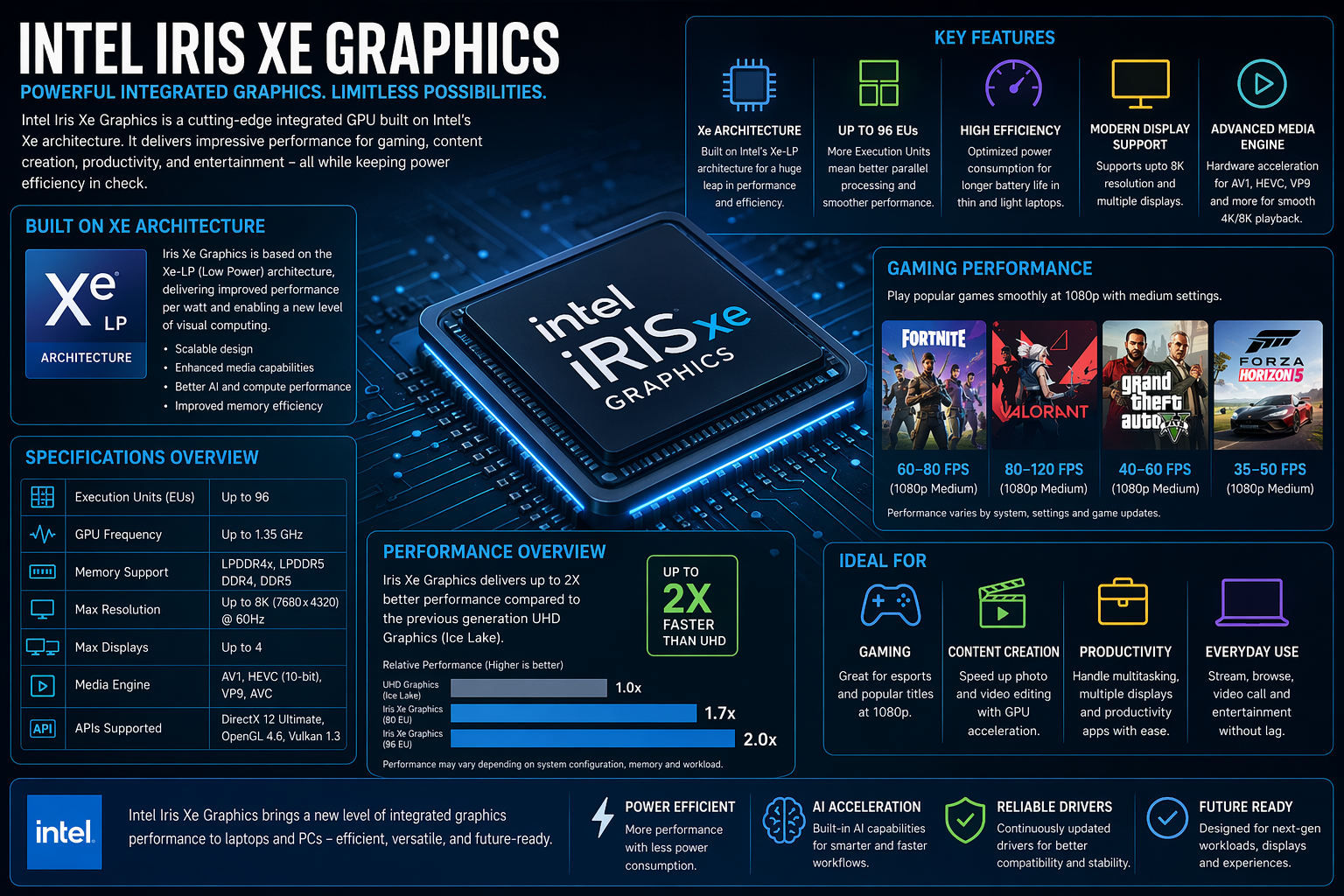
Intel Iris Xe Graphics is built on the Xe architecture, specifically the Xe-LP (Low Power) variant. This architecture represents a complete redesign compared to Intel’s older UHD Graphics lineup. Instead of just tweaking existing designs, Intel reimagined how integrated graphics should function in a modern computing environment.
One of the key elements of the Xe architecture is its use of Execution Units (EUs). These units handle parallel processing tasks, which are essential for graphics rendering and compute workloads. Iris Xe configurations can include up to 96 EUs, significantly boosting performance compared to previous generations. This increase allows for better multitasking and smoother handling of graphics-intensive applications.
Another important aspect is the improved memory bandwidth. Iris Xe leverages fast system memory, often LPDDR4X or LPDDR5, to compensate for the lack of dedicated VRAM. While integrated GPUs traditionally struggled with memory limitations, Iris Xe’s efficient architecture ensures better utilization intel iris xe graphics of available resources. This results in noticeable performance gains in both gaming and professional applications.
Finally, the architecture includes enhanced media engines and display capabilities. Support for modern codecs, higher resolutions, and multiple displays makes Iris Xe suitable for everything from video editing to multi-monitor productivity setups. It’s clear that Intel designed this architecture with versatility in mind.
Performance Overview: What You Can Expect
Performance is where Intel Iris Xe Graphics truly shines compared to earlier integrated solutions. While it doesn’t aim to replace high-end dedicated GPUs, it performs remarkably well within its category. For everyday users, the difference is immediately noticeable—faster load times, smoother animations, and better responsiveness.
In synthetic benchmarks, Iris Xe often competes with entry-level discrete GPUs. This is a significant achievement for an integrated solution. Tasks like photo editing, light video editing, and even some 3D rendering become much more accessible. Users who previously needed a dedicated GPU for such tasks may find Iris Xe more than sufficient.
Real-world performance is equally impressive. Applications like Adobe Photoshop, Premiere Pro, and even some CAD tools run smoothly on Iris Xe-equipped systems. The GPU’s ability to handle parallel workloads efficiently ensures that creative professionals can work without constant slowdowns.
However, it’s important to set realistic expectations. While Iris Xe intel iris xe graphics is powerful for an integrated GPU, it still has limitations. Extremely demanding tasks, such as high-end 3D rendering or AAA gaming at ultra settings, will push it to its limits. That said, for the majority of users, it offers a well-rounded and capable experience.
Gaming Performance on Intel Iris Xe
Gaming is one of the most talked-about aspects of Intel Iris Xe Graphics, and for good reason. For the first time, integrated graphics can deliver a genuinely enjoyable gaming experience without requiring a dedicated GPU.
Casual and esports titles run particularly well. Games like Fortnite, Valorant, and League of Legends can achieve smooth frame rates at medium to high settings. This makes Iris Xe an excellent choice for students and casual gamers who want a reliable gaming experience without investing in expensive hardware.
For more demanding titles, performance depends on optimization and settings. Many modern games are playable at low to medium settings, often at 720p or 1080p resolution. While you won’t get ultra settings or ray tracing, the experience is still enjoyable. Technologies like dynamic resolution scaling and in-game optimization settings help maintain playable frame rates.
Another advantage is driver optimization. Intel has been actively improving its graphics drivers, ensuring better compatibility and performance across a wide range of games. This ongoing support is crucial, as it means performance can improve over time with updates.
Content Creation and Professional Workloads
Intel Iris Xe Graphics is not just about gaming—it also excels in content creation and professional tasks. This is an area where integrated GPUs traditionally struggled, but Iris Xe changes the game.
For photo editing, applications like Adobe Lightroom and Photoshop benefit from GPU acceleration. Tasks such as applying filters, resizing images, and working with high-resolution files become faster and more efficient. The GPU handles these operations smoothly, reducing lag and improving workflow.
Video editing is another area where Iris Xe performs well. It supports hardware acceleration for popular codecs, making video playback and rendering faster. While it may not match high-end GPUs for complex projects, it’s more than capable of handling 1080p and even some 4K editing tasks.
In addition, Iris Xe supports AI-based features in various applications. From background removal to image enhancement, these features rely on GPU acceleration. The inclusion of AI capabilities makes Iris Xe a forward-looking solution for modern creative workflows.
Power Efficiency and Thermal Performance
One of the biggest advantages of Intel Iris Xe Graphics is its power efficiency. Since it’s integrated into the CPU, it shares power resources and is designed to operate within tight thermal limits. This makes it ideal for laptops and ultrabooks.
Power efficiency translates to better battery life. Users can enjoy longer usage times without sacrificing performance. Whether you’re working on documents, streaming videos, or playing games, Iris Xe ensures that your device remains energy-efficient.
Thermal performance is equally important. Integrated GPUs generate less heat compared to dedicated GPUs, which means quieter operation and less need for aggressive cooling solutions. This is particularly beneficial for thin and light laptops, where space for cooling systems is limited.
Overall, Iris Xe strikes a balance between performance and efficiency. It delivers strong graphical capabilities without compromising on battery life or thermal stability.
Display and Media Capabilities
Intel Iris Xe Graphics offers impressive display and media capabilities, making it a versatile choice for modern users. It supports high-resolution displays, including 4K and even 8K output in some configurations.
The GPU also supports multiple displays, allowing users to connect external monitors for enhanced productivity. This is especially useful for professionals who need more screen space for multitasking. Whether you’re editing videos, coding, or managing spreadsheets, multiple displays can significantly improve efficiency.
Media playback is another strong point. Iris Xe includes hardware acceleration for popular video codecs like HEVC, VP9, and AV1. This ensures smooth playback of high-quality videos without putting excessive strain on the CPU.
Streaming and video conferencing also benefit from these capabilities. With more people working remotely, having a GPU that can handle high-quality video streams efficiently is a major advantage.
Comparison with Previous Intel Graphics
Compared to older Intel integrated graphics, Iris Xe represents a massive leap forward. Previous generations, such as Intel UHD Graphics, were limited in both performance and features. They were suitable for basic tasks but struggled with anything more demanding.
Iris Xe addresses these limitations by offering significantly higher performance, better driver support, and modern features. The increase in Execution Units, improved architecture, and enhanced memory bandwidth all contribute to this improvement.
In real-world usage, the difference is night and day. Tasks that once felt sluggish now run smoothly. Gaming, content creation, and multitasking are all more enjoyable experiences. This makes Iris Xe a worthwhile upgrade for anyone coming from older integrated graphics.
Limitations and Considerations
While Intel Iris Xe Graphics is impressive, it’s not without its limitations. Understanding these limitations is important for making informed decisions.
One of the main constraints is shared memory. Since Iris Xe uses system RAM instead of dedicated VRAM, it may face bandwidth limitations in certain scenarios. This can affect performance in memory-intensive tasks.
Another limitation is its performance ceiling. While it handles many tasks well, it cannot compete with mid-range or high-end dedicated GPUs. Users who require top-tier performance for gaming or professional work may still need a discrete GPU.
Driver maturity, although improved, can still be an issue in some cases. While Intel has made significant progress, occasional compatibility issues may arise with certain applications or games.
Who Should Use Intel Iris Xe Graphics?
Intel Iris Xe Graphics is ideal for a wide range of users. Students, professionals, and casual gamers can all benefit from its capabilities. It offers a balanced performance that suits everyday computing needs.
For students, Iris Xe provides enough power for assignments, presentations, and even light gaming. It eliminates the need for a dedicated GPU, making laptops more affordable and portable.
Professionals who work with documents, spreadsheets, and creative tools will also find Iris Xe sufficient. Its ability to handle multitasking and GPU-accelerated applications makes it a reliable choice.
Casual gamers will appreciate its ability to run popular titles smoothly. While it’s not designed for hardcore gaming, it delivers a satisfying experience for most users.
Future of Intel Integrated Graphics
Intel Iris Xe Graphics is just the beginning of a new era for integrated GPUs. Intel’s Xe architecture lays the foundation for future advancements, including more powerful integrated solutions and dedicated GPUs.
As technology evolves, we can expect further improvements in performance, efficiency, and features. AI integration, better ray tracing capabilities, and enhanced driver support are all areas of potential growth.
The success of Iris Xe also signals a shift in the industry. Integrated graphics are no longer an afterthought—they are becoming a viable alternative to dedicated GPUs for many users. This trend is likely to continue as manufacturers push the boundaries of what integrated solutions can achieve.
Final Thoughts
Intel Iris Xe Graphics represents a significant step forward in integrated GPU technology. It combines performance, efficiency, and versatility in a way that meets the needs of modern users. While it may not replace high-end GPUs, it offers a compelling alternative for those who value portability and efficiency.
From gaming to content creation, Iris Xe proves that integrated graphics can be powerful and capable. It’s a testament to how far technology has come and a glimpse into the future of computing.
For anyone considering a new laptop or upgrade, Intel Iris Xe Graphics is definitely worth paying attention to. It delivers more than just incremental improvements—it redefines what integrated graphics can do.
YOU MAY HAVE MISSED
About the Author